The Soul Energy
Sacred Journeys. Soul Tales. Energy Healing
Temple of Nature

The river meandered through an inlet, cordoning it into a secluded hidden area. The dense foliage converting the vicinity into a world of green, as sunlight streaked in through the leaves from the surrounding trees. The water was also an exotic fluid carpet dotted with lotus leaves, with an occasional purple pink flower accentuating the beauty.
It was in this breathtaking world where the earth, the sky and the water, all seemed to merge together into a seamless spectrum of green that the kayak entered with its two occupants. Ridhima and Meera had strayed into the inlet by mistake. The two girls were in Thailand for a holiday and were part of a group which had opted for a kayaking excursion.

As they stared in amazement at the stunningly beautiful world they had strayed into, each reacted differently. For Ridhima it seemed that she had entered a magical temple of nature, pulsating with an unknown energy she could not understand, but feel. Meera, on the contrary was actually scared, as the whole environment was too alien for her to comprehend.
What however piqued the curiosity of both girls was a small figurine in green, which almost seemed lifelike, sitting in a meditative stance with eyes closed, on one of the lotus leaves. They wondered who would have put this figurine in this unusual place and for sometime they kept staring at it as if mesmerised, before retreating and joining the others who were calling out to them.
As soon as the kayak was out of sight, the being on the lotus leaf, opened his eyes. He did not like getting disturbed, but once in a while if a human entered his sanctuary, they never left without getting a gift from him.
The girls returned back to India and for many days they kept seeing dreams of entering the green inlet and the figurine. It seemed that they were transported into a magical world again and again. Unknown to them, the experience had changed them profoundly. Ridhima, who was a nature lover, started discovering that every blade of glass, each flower and leaf, pulsates with an energy, the same that she had discovered in the inlet. While Meera realised that she was afraid no more of things that she could not identify with, and in time also understood that nothing was actually alien in this world, there was a seamless uniformity which pervaded everything.
The gift had come to pass.
A Tale of the Afterlife

The tribe of Yohans took great pride in their traditions as most indigenous communities do. They lived in an interior segment of North East India and preferred seclusion from the other hill tribes in the region. One of the reasons for this has been their strong focus on the afterlife, which many times preceded even the calling of their present life.
Their village bordered the marshy inlet of the Great Lake that has since as long as the inhabitants remember, witnessed a unique phenomenon. On certain days of the year, balls of light have shot up from the lake and disappeared into the night. The Yohans have always believed that the Great Lake has been home to their ancestors and a sacred water body. They cremated the dead, but made a small idol of the deceased and immersed it with the ashes in the lake. Along with it they also immersed miniature replicas of clay utensils, bed, everything one needed at home. According to them, their ancestors carried out their everyday activities at the bottom of the lake. And when these lights appeared, the souls finally got freedom from their watery world and merged with the infinite.

The village potter, Sham, who created these little idols, was devastated when his little son died due to a mysterious illness. He crafted with loving care the tiny idol of the boy and all the things the child liked. After completing the last rites and submerging the idol, he started spending hours at the lake every night worried about his son at the bottom of the lake. He kept praying for the boy’s soul to merge with God at the earliest.
Sham was sure that whenever the lights appeared, he would know which was his son. More than seven months passed, then one night he saw a small ball of light emerge from the lake along with a few larger ones. His heart skipped a beat as it hovered over the water, and as Sham went near the water’s edge, it seemed to flicker in front of him, before disappearing. It was only then that the grieving father’s heart found a closure, sure that his son was being taken care of by the supreme God.
While science would explain the lights on the lake as phosphine gas bubbles, for the Yohans it is a matter of faith. Which is the greater truth? That which the heart seeks to believe, of course.
The True Mirror

Sanofa was a being of the magical realm – wispy creations of God, sometimes seen, but mostly invisible to human eyes even though they are all around – hidden among the leaves, mosses, feathers and clouds. Sanofa was the odd one, she never really cared how she looked, so busy was she flitting around doing things that made her feel useful. Straightening the petal of a blooming flower, pushing a vine to get sunlight for growth, helping a bee extract the honey it needed. There was never enough time for her to prune and preen. In the magical realm of beautiful creatures, she was known as the Dishevelled One.
Sometimes, she would look into the mirror and wonder. She loved herself but did not like what she saw on the other side. One day after cleaning up a pond of a diseased algae which would have killed the lotus flowers, she stood before the mirror again to see how she appeared. Her heart weighed down heavy as she realised she would never belong. Suddenly she saw the apparition of a beautiful goddess like being emerging from herself and gliding in front of her. The apparition then disappeared into the mirror, which showed nothing different. After a while the apparition came out from the mirror and merged into Sanofa again.

She was perplexed – who was this enchanting being who resided in her? What did this goddess want to communicate? Too many questions plagued Sanofa’s mind as she made her way to the Wise One. The Wise One lived on a cotton tree and looked like a ball of cotton herself – wizened, old and white. But she knew the secrets of all realms and was revered by all.
Hearing Sanofa’s account of the mysterious goddess, the Wise One asked her to seek the answer from her own heart. A bit sceptical, but not having the courage to disobey the Wise One, she did as told. As Sanofa placed her hand on her heart, closed her eyes, and quietened her restless mind, she could feel the goddess speak. The beauty of the moment overwhelmed her so much that she started crying. She opened her eyes to look with gratitude at the Wise One, who was smiling knowingly. For Sanofa had realised that what she had seen was no goddess, it was her own heart which had shown her its beautiful image. And, she knew now that the true mirror was within one’s own self, not a piece of glass outside.
Under the Peepal Tree

She sat there all day long, under the massive Peepal tree (sacred fig) next to a tributary of Gomti river. The children would go and sit around her, trying to catch her glance. She would smile at them sometimes and often make some signs. She never spoke though. The villagers understood she had taken a vow of silence.
They called her the Yogini (a female Yogi). No one knew who she was or where she had come from. Just one day, they found her meditating under the Peepal tree, outside the village. Soon the villagers started telling their problems to her. They were never sure whether she was listening to them or not, but they always believed that speaking before her would resolve the issue. The sick then started visiting and vouched that their conditions improved in her presence. She would sometimes throw a leaf or a twig at them which they believed cured their ailments.
Her calm presence affected them so much that the fact that she was a woman, unusual for a Yogi, did not matter to the simple villagers. Before the monsoons they built a little hut for her near the tree, so that she could be protected from the heavy rains. She never got to live there though. The first rain that came was torrential, the cloud-burst almost flooded the outskirts of the village and the river overflowed its banks.
When the waters receded, the villagers went to check on her, but could not locate the Yogini. They only found a few scattered belongings. They started believing that the waters had taken her away and grieved her death.
There were others who believed that she was never gone – she still blessed them at the sacred Peepal tree, which is known to be a home for devas and nature beings. For in the last 50 years since the incident happened, many times young children have seen her under the tree. The villagers continue to go there and pray for the resolution of their problems. The place where they had built her hut, is now a shrine in her memory.
In a society where women mystics and seers have not always got much recognition, this could have been the reason why the Yogini went to a little forgotten village to spend the last few months of her life. She probably knew that the simple faith the village folk had in their hearts would be much stronger than the parochial views of the outside world. And that, she would continue to bless them as long as this faith lasted.
The Essence of Play

The joy of the soul
The beat of the heart
The dance of the spirit
The rhythm of breath
Every moment of life
Is a glorious play of consciousness.

The shine in the eyes
The call of the wild
The whisper of leaves
The laughter of a child
Every expression
Is a reflection of your vital energy.
The warmth of the sun
The turbulence of the wind
The solace of water
The comfort of the earth
Every element
Is a manifestation of your will.
O Supreme Mother !
The divine essence of life
Our inner and outer universe is your endless play.
The Elixir: An Atlantean Tale

Shahan’s heart skipped a beat as the ground beneath her feet trembled. This has been happening since the last 12 days. She made her way quickly to the Elixir Temple. She was one among the 15 Shikas who were serving at the temple from a very young age. Kept in seclusion, and away from their families, they were all chosen on the basis of one fact – the spiritual heritage of their parents.
From the age of five till they reached puberty, they served as the revered Shikas, the attendants to the goddess at the Elixir Temple. The goddess was worshipped as a stone, which some said had come from the core of the earth, while others claimed it fell from the sky. The task of these young girls was to go in a chariot and fetch fresh spring water in their little golden pitchers and pour it in the gigantic golden vat, within which the stone was kept. No one else was allowed to touch the water. Every 21st day the tap of the vat was opened to empty out the pale yellow liquid, which had now become the elixir – a divine potion which could give longevity to the inhabitants of the land and ultimately immortality. It had to be earned of course, only those who had been recognised for their great moral principles, valour or philanthropy, had the right to it. The high priestess of the temple and the council decided whom it should be given.
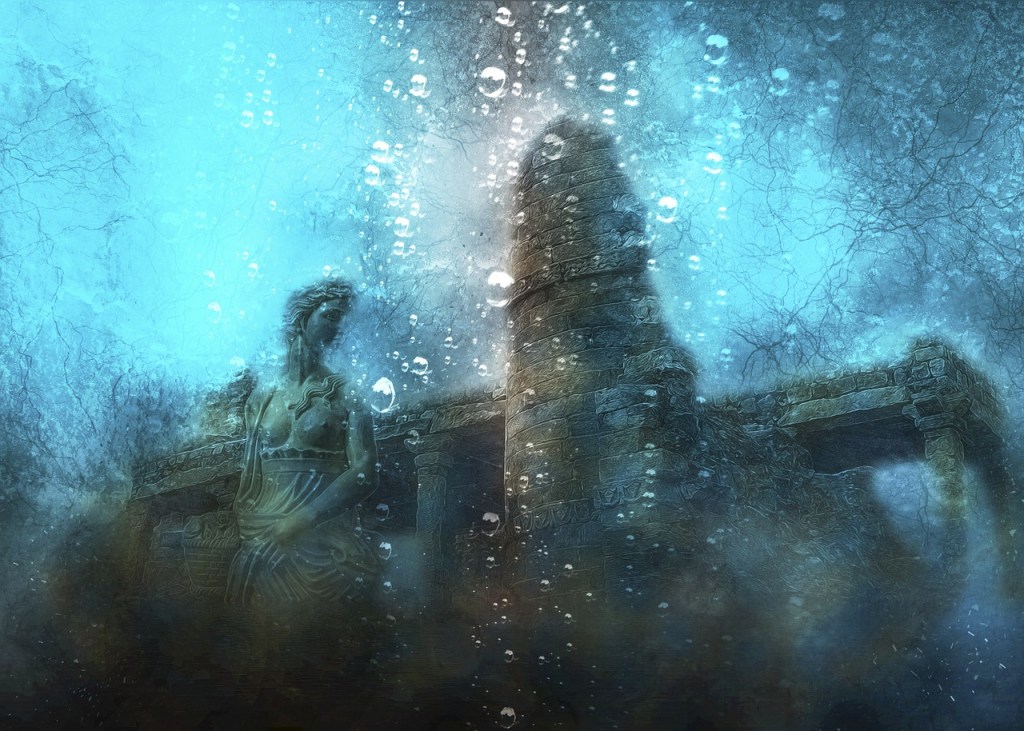
As Shahan stood outside the temple, carrying her pitcher, she could see the high waves approaching from a distance. She was terrified and wondered if she should give some elixir to her parents. She wanted to discuss this with her younger sister who was also a Shika. Shahan never got an opportunity though. That very night a massive earthquake wiped out the island from the face of the earth.
The vat of elixir, waiting to be consumed by some illustrious Atlanteans, fell at the bottom of the ocean, spilling its contents amidst some creatures of the deep, like jellyfish, lobsters, turtles and clams, mutating their DNA forever. If you wonder why the Turritopsis dohrnii is an immortal jellyfish that can reverse its aging or how lobsters, clams and turtles have such a long life, the answer is a stone still lying inside a golden vat, somewhere on the ocean bed, lost to man forever.
Bonds Beyond Death

The heritage homestay by the sea was seldom occupied. Most guests who came here were either not able to cross the state borders before nightfall or had to make a halt due to an emergency. Johanpal, the owner, did not actually care much as long as enough guests kept trickling in to pay the salary for his staff. It was not easy for him to retain the employees of course, for the stretch of beach on which the solitary haveli (heritage mansion) stood, was believed to be haunted.
The haveli was his ancestral property. Johanpal could never understand why his great grandfather had decided to build this beautiful structure in this area more than 120 years ago. The seashore had been the site of a great battle once, between the Rajput soldiers and invading forces. Unfortunately, the cavalry of valiant Rajputs could not keep the marauding invaders away, and had been mercilessly slayed.

For as long as he had known, the beach was known to have seen strange sightings – while some people said they had seen flickering lights others claimed to have heard sounds of horse hooves. The last, he knew, was true. In the last 40 years, Johanpal had himself seen an unearthly vision a few times. On a full moon night, the sea shore had turned into a surreal site – he could see a team of horses, their silvery white bodies glistening, waiting on the shore, looking towards the sea. It was as if they were waiting for their masters, the brave soldiers who had lost their lives, to rise up from the waters, and unite with them again. Every time, he had seen the magnificent ghostly animals, it had left him with a feeling of strange sadness.
It was a full moon night again. Johanpal and his family were grieving the death of their beloved Pomeranian, who had died two days ago due to a sudden illness. They lovingly called her Queen, for she ruled the hearts of everyone in his family – his wife and two sons. For Johanpal, Queen was like his young daughter, and he was finding it extremely difficult to cope with the grief of losing her.
As he stood on the terrace looking towards the sea, after many years, he saw the horses again – waiting endlessly for their masters. Then suddenly, he could make out a little figure, darting from the seashore running fast towards his home. As it approached the building, he could unmistakably make out the little form of Queen. She stood below the terrace looking up at him, wagging her tail tirelessly as she always did. Then, in an instant, she was gone, and so did the horses.
Johanpal then realised that death had not snatched away Queen forever, she had probably appeared to make him understand that. As he climbed down the stairs to share with his family what he had seen, his heart had already started to heal.
Eternal Play

The priest closed the doors that led to the inner sanctum of the temple, and went home. The silence of the night was only disturbed by the distant barking of street dogs.
The temple, one of the most famous in southern India, was known for its musical pillars. People from all over the world have come here through the ages to gaze in awe at the remarkable architectural feat of the ancient craftsmen who had created such a wonder – both for its beautiful sculptures and the musical notes the pillars produced.

What the thousands of worshippers who thronged here did not know was that often at night, the very premises became a playground for divine beings – it was among the favourite haunts of the Lord of Plays, Krishna, his consort Radha, and the many Gopis and Gopikas. From the sacred groves to the banks of Yamuna river, from mountainous valleys to his many temples, when the world slept, the celestial Gandharvas would tune in with the elements to create music for Krishna’s dance of divine love (Rasleela).
Beyond human perception – the cosmic play goes on endlessly. Sometimes a fortunate few would pick up the energy and their hearts would sing with an unknown joy. They are unaware of course that their soul has reconnected with an energy which is always present in the core of their being – eternal joy, eternal play.
The Hibiscus Garland

Praneja came from a family of priests, who took great pride in their vocation. Since five generations the eldest male member of her family had been the head priest of the temple sanctuary in the northern fringe of the forest near Rajgriha, the ancient capital of Magadha.
Every morning at the break of dawn she would go and collect flowers from the vast temple garden and create an exquisite garland for Goddess Kali, who was the presiding deity of the temple. As Praneja would look with great love and devotion in her heart at the beautiful dark visage of the mother goddess she would feel one with the deity.
She would often wonder if the supreme primordial energy was feminine, then why were women not allowed to be priests in the temple. Her job was only to make the beautiful garland of flowers, she was never allowed to place it on the idol – that privilege only the male head priest had.

One morning when Praneja returned to the temple after collecting exquisite red hibiscus flowers – the goddess’ favourite, she sat down to make the garland. Suddenly, she noticed a little girl standing next to her. Praneja had never seen the child before, so she asked, “Who are you and what are you doing here so early in the morning. The temple is yet to open for public.”
The girl held out her hand and exclaimed, “Such beautiful flowers, I love them. Please make a small garland for me.” Praneja tried to reason with her and said gently, “I can’t little one, this is only for Mother Kali.”
Hearing this, the little girl clutched Praneja’s hand and started pleading with tears in eyes. Praneja knew that soon her father would come and start the morning worship, he would not be pleased to see the garland was not yet ready. She had other work to do also like make the sandalwood paste and put together all the other things for the rituals. So, to make the child leave she quickly strung a few flowers together, made a little garland and placed it around the neck of the girl. “Now off you go, I have a lot of work to do before my father, the head priest comes,” she said, patting the girl. The child smiled and ran away, without saying any word or even thanking her.
Praneja sat down to finish all her work and soon her father arrived. As he started the rituals, he exclaimed, “What is this? Who has placed this garland on the idol of Mother Kali.”
Praneja was astounded, she had been so engrossed in her work that she did not realise that the small garland she had made for the child now adorned the neck of the goddess.
She knew now who the little girl was. Her heart filled with gratitude as she realised the goddess had come as a child to accept her garland and make her value the devotion that she had in her heart, and not just focus on the ritual of worship which only the men were allowed to do.
Goddess Kali, the manifestation of the supreme primordial energy, had herself appeared to make her understand a great truth.
The Blue Rose

There comes a holy and transparent time when every touch of beauty opens the heart to tears.
This is the time the Beloved of heaven is brought tenderly on earth. This is the time of the opening of the ROSE.
– Rumi
The evening sun was setting, the sky was covered in multiple hues of gold and red. The peaceful environment of the beautiful royal garden with its trees and plants sourced from all over the world, could not quieten the troubled mind of prince Shahzad.
A few days ago, his two elder brothers who had gone for a hunting expedition to the nearby forest were waylaid and killed by robbers. But Shahzad knew no robber had the courage to slaughter a royal hunting party, he was well aware who was behind the many strange deaths in the royal family in the last few months.
It had all started some months ago with the poisoning of the then crown prince, who was succeeded by his younger brother. Shahzad was certain that it was the current crown prince, who was removing all opposition to his succession by getting the princes in the family killed.
A young cousin to the crown prince, Shahzad’s life was in danger as well. The path to the Mughal throne had always been steeped in blood, but there had never been so much blood spilled. Shahzad had left his chamber to find some peace in his favourite corner of the royal garden near the marble baradari (pavilion), the spot which had a collection of the rare blue rose.
A nature lover, the prince was fascinated by this exotic flower, and had himself brought the blue rose saplings from Isfahan in Iran and planted them here. As he looked to admire their beauty for the umpteen time, he felt as if someone was watching him.
He glanced around but saw no one. Then he heard some music, it was so faint that the sound seemed to be coming from within his left ear. Startled, something made him look up.
He was astounded by what he saw – parallel to the dome above the baradari, floating in the air, were seven flowers. In each flower was sitting, what seemed like, a celestial being.
The five who were female, were all watching him, while one male was playing the mridangam (an ancient Indian percussion instrument) and the other who was wearing a green dance mask had cymbals in his hands. Then in a flash, they were gone.
Did his troubled mind imagine the breathtaking vision? Did he unknowingly fall asleep, and dreamt it all? Was it a trick of light reflected by the multicoloured mosaic on the dome? Shahzad had too many questions in his mind.
He returned to his chamber and knew he could not share what he saw and heard with anyone, but he felt a strange lightness of heart and happiness.
He picked up his quill and started writing, to express what he felt and could feel a wave of bliss wash over him. The outpouring was like a floodgate of words, and after sometime he was astonished that he had written a beautiful poem on The Blue Rose.
He realised the process of writing was making him connect to the inner core of his being, to a sacred and precious place, which he wanted to continue. Day and night he would sit and write beautiful verses, which gradually started getting noticed by other members of the royal household. The crown prince, who took great pride in being a patron of arts, also heard of Shahzad’s writings, and started admiring what his young cousin wrote.
A few months passed, the killings in the royal family abated with the crown prince taking over as the emperor.
Shahzad was one of the very few who was spared – the vision had made a poet out of him and saved his life. He lived a long life as a celebrated poet whose work was admired for generations to come.
And, if you are wondering did those nature beings appear to him again, the answer is yes, a few times. Whenever he faced the most challenging moments in his life, they appeared in different forms in different ways, always taking his breath away, and reigniting in his heart the love for life and laughter.